





Erny
Expertise
Two-sided product design
Native iOS craft
Behavior systems
Kid-safe UX
AI-assisted build
Role
Designer-founder (product, iOS, web) (Solo build, AI-assisted)
A transparent family economy with rules kids can trust and parents control
Overview
The design problem was not a better chore list. It was a two-sided behavioral system: parents needed a single source of truth for rules and follow-through; kids needed visible progress, fair rewards, and a reason to come back without feeling surveilled.
Existing tools failed at the systems layer. Chore charts had no economy. To-do apps had no approvals. Reward apps often hid rules from parents or let kids game the ledger. None of them reduced the daily negotiation loop.
I designed Erny around one constraint: every economic action flows through a parent approval gate, enforced server-side. Children join through a parent-controlled token, not a kid account. Points are spendable; XP is permanent and feeds a six-domain skill map and character progression.
I built it with my daughters, Sofiia and Elli. They set reward prices, rejected preachy copy, and dogfooded the product before launch. That co-design loop became a feature: kids can propose tasks and rewards; parents approve what enters the catalog.
My role
I was the designer-founder: product direction, native iOS, web dashboard, and Supabase backend with family-scoped row-level security. I shipped with AI-assisted velocity but kept approvals, ledger integrity, and typed contracts non-negotiable.
The challenge
Family habits look like a simple list problem. They behave like a marketplace problem: two audiences, conflicting incentives, shared state, and high cost when trust breaks.
When kids cannot see the rules, effort feels invisible and rewards feel arbitrary. When parents cannot see the ledger, they carry the entire mental load of enforcement. The product collapses into nagging.
- Static chore charts: no economy, no approvals, no kid agency
- Punitive trackers that optimize compliance over trust
- Reward apps with opaque rules parents cannot audit
- Generic to-do tools built for individuals, not two-sided family workflows
Behavioral
Two incentives, one household
Kids optimize for immediate feedback and identity. Parents optimize for fairness, consistency, and less conflict. A system that only satisfies one side fails within a week.
Product
One product, not five features
Earn, spend, streaks, skills, and co-parent sync must feel like one product. State must stay consistent across iOS, web, and shared devices.
Systems
Trust is architectural
Every transaction is a pending request until a parent approves. Child access is token-based. Family scope is enforced in the database, not on the client.
How might we turn daily family responsibilities into motivation kids choose, while keeping parents in control of every point that moves?
Strategy
I framed Erny as a transparent family economy, not a checklist. Parents define earn rules and reward rules. Kids participate through a shareable token. Every transaction follows the same path: request, approve, ledger update.
Onboarding presets compress setup to about two minutes: age-group starter tasks and rewards, first child created, dashboard live. The web layer owns the authoritative API; iOS mirrors the same contract with typed operations and strict MVVM layering so state cannot drift between surfaces.
Motivation sits on top of the economy, not instead of it. Points answer "what can I get?" XP and the skill matrix answer "who am I becoming?" The character universe gives kids emotional feedback on pending, approved, and declined states without letting them bypass parent control.
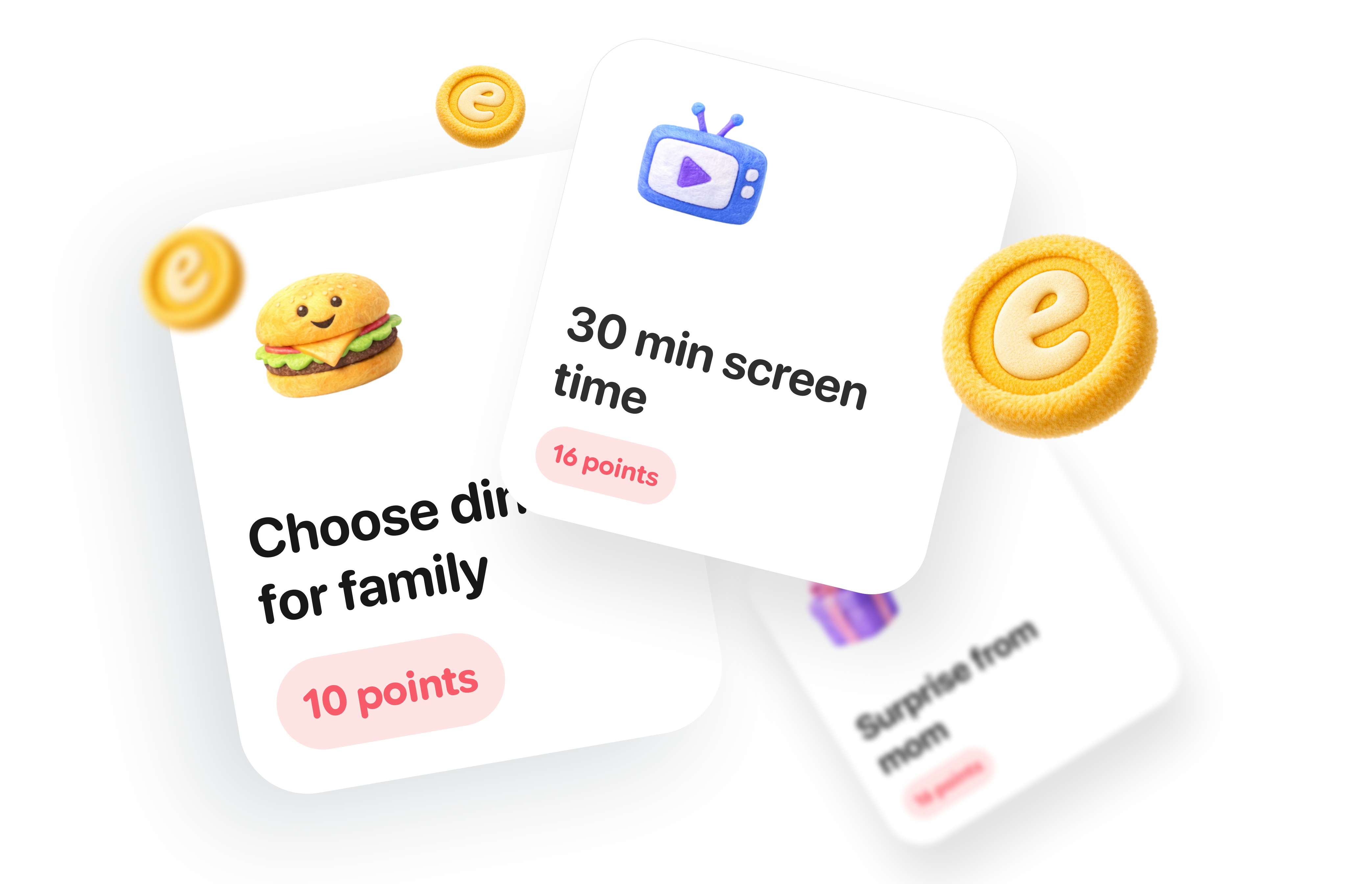
- Brush teeth · +3 points
- 30 min screen time · 16 points
- Sofiia requested reward → Approve
Four core loops
Set up, Participate, Approve, and Grow gave parents and kids one predictable rhythm. Same state machine, different surfaces.
Erny is four overlapping loops on one family ledger: earn, spend, motivation, and household scope. Each loop has different triggers and progress logic, but kids and parents must share one predictable mental model.
Set up
Define the catalog
Parent defines tasks, rewards, point values, and family context. Presets reduce blank-canvas friction; custom entries handle what presets miss.
Participate
Token access, no kid login
Child completes a task or requests a reward through token access on iOS or web. No separate kid account, no account sprawl.
Approve
One tap, atomic update
Parent approves or declines in one tap. Declines stay neutral. Approvals update balances, streaks, XP, and celebrations in one atomic moment.
Grow
Spend points, keep XP
Spent points unlock rewards. Permanent XP updates the skill matrix and character. Streaks and daily surprises maintain momentum without replacing the core loop.
Principles
Four principles kept the two-sided system coherent as features grew.
Principle 01
One ledger, two languages
Parents get fintech scannability; kids get playful warmth. The lexicon stays shared: task, reward, request, approve, streak, level.
Principle 02
Trust before delight
Every point move is auditable. Celebrations fire after approval, not before. Delight never outruns the rules parents set.
Principle 03
Agency within bounds
Kids propose tasks and rewards; parents add them to the catalog. Co-creation keeps motivation authentic without giving up control.
Principle 04
Progress you keep
Points spend down; XP never resets. Even when a reward is redeemed, effort history and skill growth remain visible.
Trade-offs
Every family product trades speed, warmth, and visibility. These were the calls that shaped Erny.
Visibility
Ambient, not noisy
Streaks, widgets, and celebrations keep progress ambient, but I capped notification ambition early. Families asked for clarity in-app, not another ping channel competing with school and messaging.
Game warmth
No shame mechanics
Multipliers and surprises increase return visits, but broken streaks never trigger shame copy and bonuses never hide the underlying rules.
Platforms
iOS depth, web parity
Widget, haptics, and character motion ship on iOS first. Web covers shared tablets, the parent dashboard, and families without iPhones in the house.
Production
Speed with guardrails
AI-assisted building accelerated solo shipping, but family scope, row-level security, typed API contracts, and modular Swift packages were non-negotiable. Trust could not be vibe-coded.
Tasks & rewards
The catalog is the contract between parent and child. If kids cannot read what earns points and what points buy, the economy fails before the first approval.
Tasks and rewards share one card pattern: icon, plain-language title, point cost. Parents set values anchored to real motivation (screen time, choosing dinner, a surprise outing). Kids browse the same catalog when deciding what to work toward. Nothing auto-applies; every earn and spend waits on a parent decision.
Skill matrix
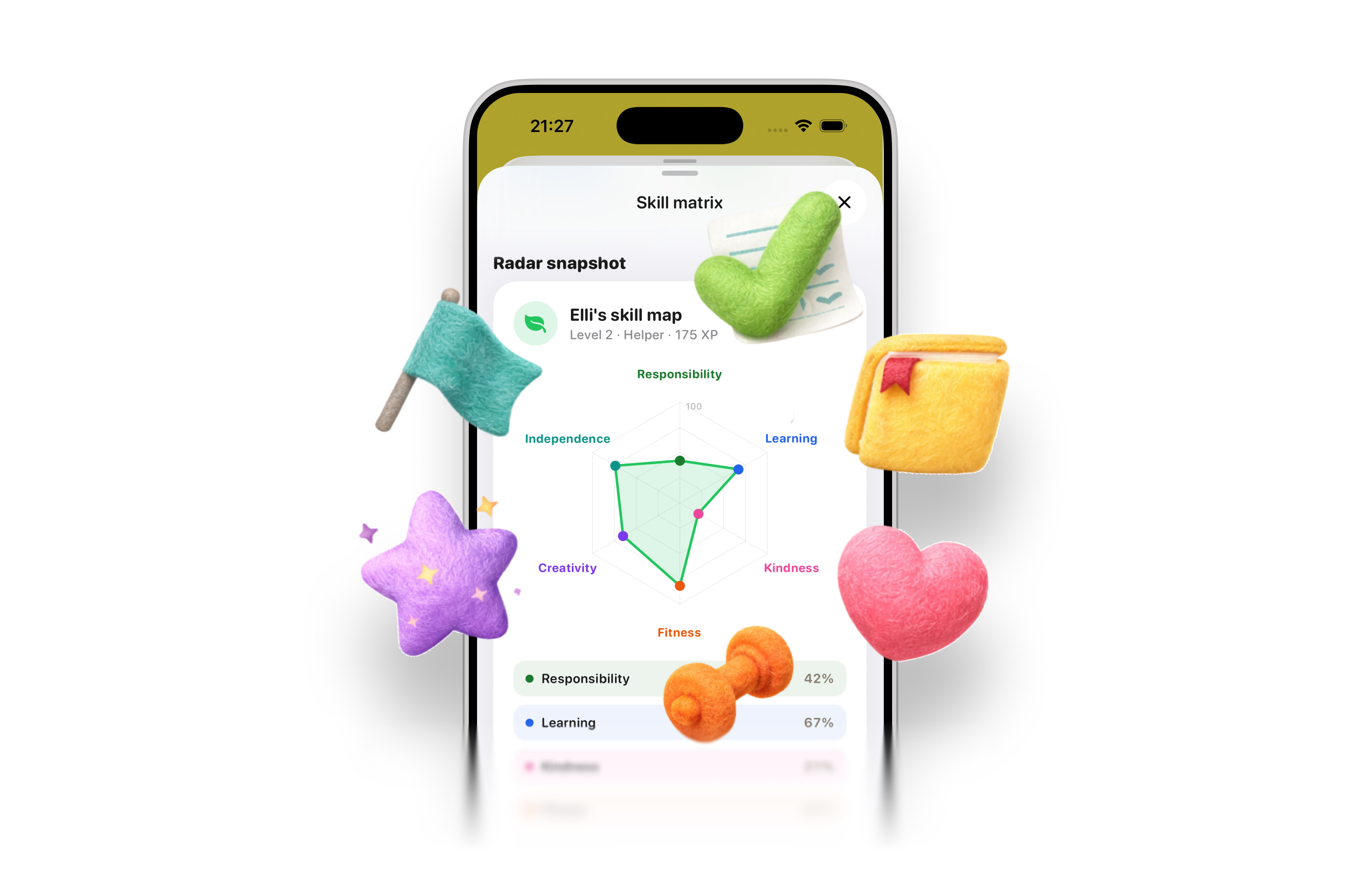
Points answer short-term motivation. XP answers long-term identity. Without a permanent progress layer, families revert to "what did you do today?" every morning.
The skill matrix maps approved tasks into six domains: responsibility, learning, kindness, fitness, creativity, independence. Kids see a radar snapshot of where they are growing. Parents see effort patterns without location tracking or surveillance mechanics.
Child home
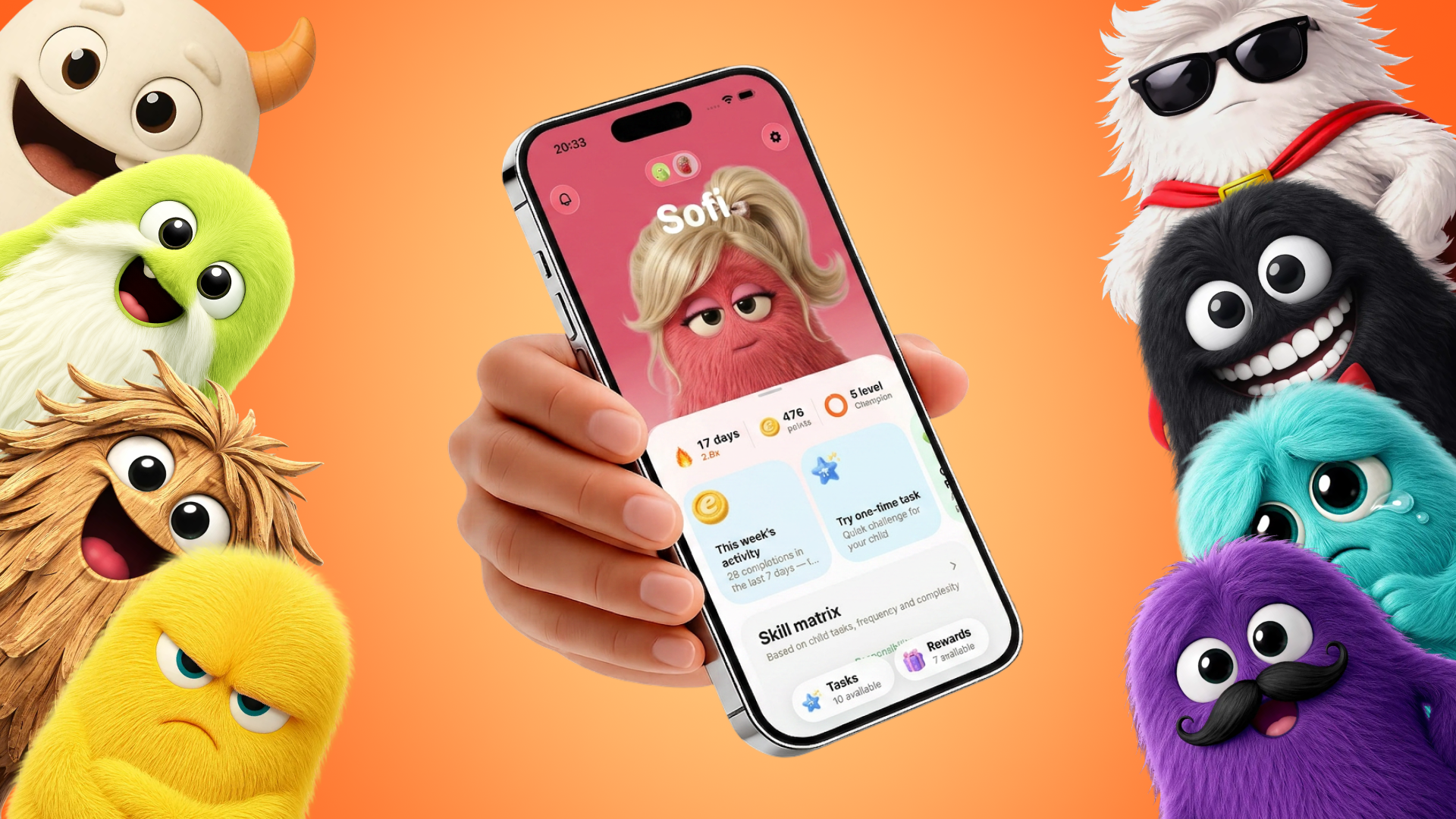
The child home is where the loops collapse into one screen: streak and balance up top, weekly activity, skill matrix entry, tasks and rewards one tap away. Erny the character adds warmth; the numbers underneath stay honest.
On Sofiia's profile you can read the full stack at a glance: 17-day streak, 476 points, level 6 Champion, ten tasks and seven rewards ready. Economy, motivation, and identity in one place. That density is intentional: kids should never hunt for what to do next.
Built with kids
Erny was not designed in a vacuum and tested later. Sofiia and Elli were in the loop from early prototypes: choosing avatars, rejecting nagging copy, negotiating whether 30 minutes of Roblox was worth 16 points or 20.
That feedback changed the product, not just the words. Custom task and reward proposals became a first-class loop. Onboarding explores a "try Erny together" moment: hand the phone to the child during setup so the first win is shared, not admin work.
- Reward prices anchored to real motivation, not adult guesses
- Celebration intensity tuned: confetti yes, patronizing praise no
- Custom proposals shipped as product, not backlog
- Live examples use their real names because the system was built on real use
If I wouldn't want my kid to read this over my shoulder, it doesn't ship.
Outcome
From daily battles to a system the family trusts
Erny replaced opaque demands with a shared scoreboard my own kids wanted to open. The beta validated demand beyond our household. The architecture is built to grow into templates, co-parent flows, and parent-side AI without compromising the approval gate that makes the system trustworthy.
App Store downloads
1000+
First week after launch
Locales shipped
3
English, Ukrainian, German
Platforms
iOS + Web
Native app, dashboard, child portal, widget
Setup time
~2 min
Onboarding presets to usable family system
ScopeNative iOS app · Next.js dashboard · Child web portal · Supabase backend
TeamDesigner-founder · Solo build · AI-assisted